
Inverter or Conventional AC: Which Pays Off in Georgia
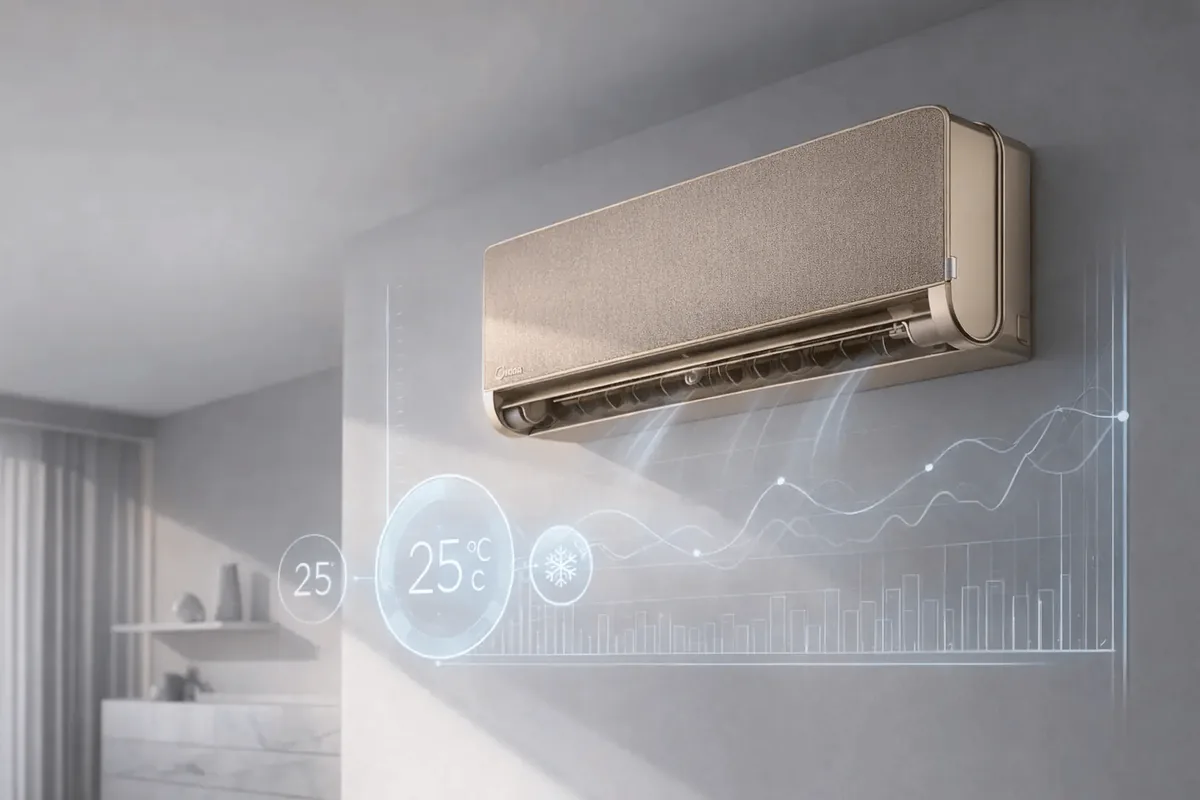
How inverter technology works
A conventional (On/Off) air conditioner has two states: running at full power or off. It reaches the set temperature, then switches off. It warms up by 2–3 degrees, then switches on again. It's like driving with the pedal floored, then a full stop, over and over.
An inverter compressor works differently. A frequency converter smoothly varies the speed: once it reaches the target temperature it drops to 15–20 % power and holds it. No abrupt starts, no swings. The temperature stays steady to within ±0.5 °C.
Consumption compared: real figures for Georgia
Take a 12,000 BTU model. Summer in Tbilisi. 8 hours a day, 120 days a season, a tariff of 0.25 GEL/kWh:
- On/Off: 8–10 kWh/day → 960–1,200 kWh/season → 240–300 GEL
- Inverter: 4–6 kWh/day → 480–720 kWh/season → 120–180 GEL
That's up to 150 GEL saved every season. Over 5 years — 750 GEL. With a 400–600 GEL price gap between inverter and On/Off, it pays back in 3–4 seasons.
Inverter models in the catalogue
Filter by area, capacity and price. Every model has a turnkey quote with installation.
See invertersComfort: what you can't measure in GEL
An inverter wins on more than money:
- Quiet: 20–24 dB versus 32–38 dB at On/Off start-up. The difference is noticeable, especially at night
- No draughts: smooth running without sudden blasts of icy air
- Steady temperature: no “cold — hot — cold” cycles
- Fast to reach the set point: the inverter runs at full power first, then eases off
For a bedroom or a child's room an inverter isn't a luxury — it's a baseline comfort requirement.
When On/Off still makes sense
The honest answer: almost never. But there are exceptions:
- The AC is used less than 2 months a year (a country house, a seasonal office)
- The budget is tight and even a 400 GEL difference matters
- The space isn't residential: a warehouse, garage or storeroom
In every other case an inverter is the rational choice. Not “premium” — the standard for modern air conditioning. We keep On/Off models in the catalogue for exactly these jobs.
Lifespan and durability
An On/Off compressor takes a start-up load every time it switches on. It's like a cold engine start: wear is highest in the first seconds. Across a day that's dozens of such cycles.
An inverter compressor runs continuously at optimal speed. No start-up shocks means no extra wear. The result: 30–40 % more compressor life. Average service life is 12–15 years for an inverter versus 8–10 for On/Off.
The Midea inverter range in our catalogue
We work with Midea — one of the world's largest makers of climate equipment. In the catalogue:
- Midea Mission — a balance of price and features, from 9,000 to 24,000 BTU
- Midea Xtreme Save — maximum energy efficiency, A++
- Midea BreezeleSS — minimal noise from 20 dB, a dedicated sleep mode
Every model is inverter, R32, with Wi-Fi. See the Midea catalogue — delivery and installation across Tbilisi.