
Installing an AC: What to Know Before the Job
The pre-installation survey: what the specialist checks
Before drilling walls, you need to know what you're working with. The technician assesses:
- The room layout and the best spot for the indoor unit
- The distance to the facade — it sets the length of the copper line
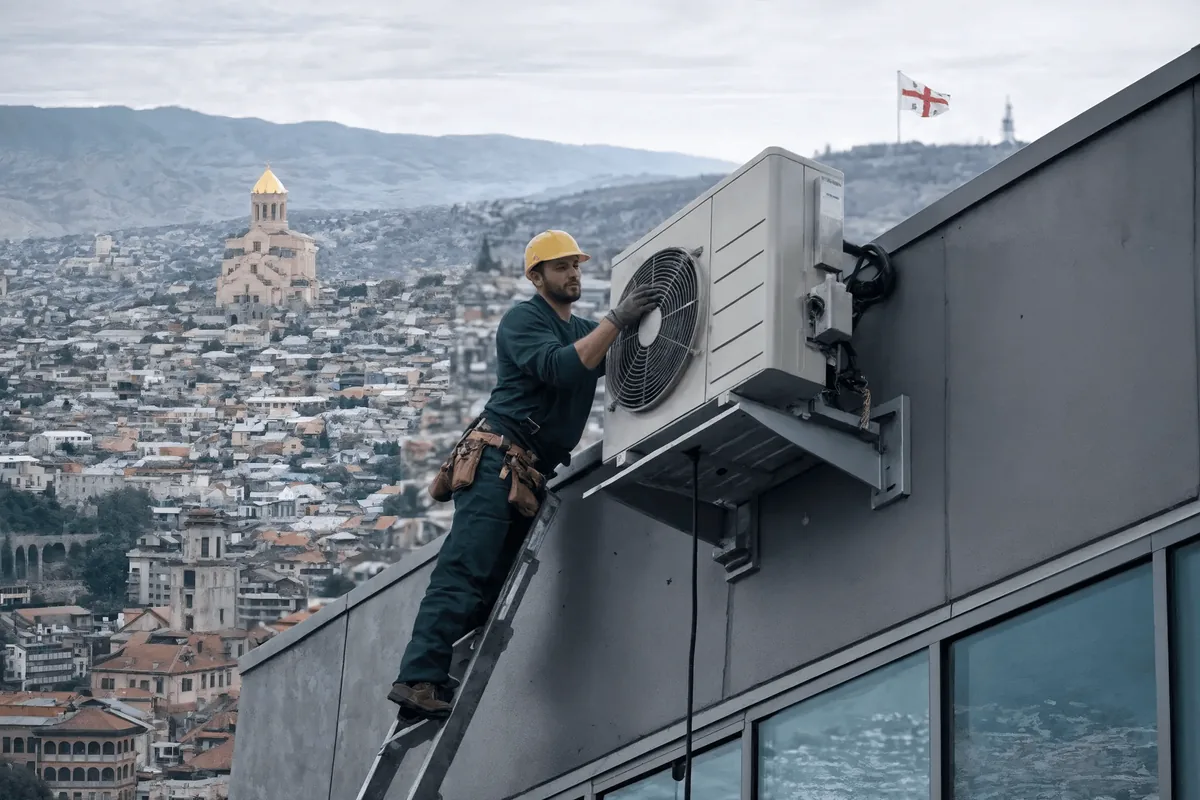
- Access to the wall for mounting the outdoor unit (brackets, a cherry picker, rope access)
- A dedicated electrical line of the right gauge
- Drainage options — out to the facade or to the sewer
This stage is free when you book the installation with us. And it's critical: a mistake at the planning stage costs more than the installation itself.
Indoor unit placement: rules you can't break
Minimum clearances aren't a recommendation — they're a technical requirement:
- 15 cm from the ceiling — for free air intake from above
- 10 cm from the side wall — for servicing and air circulation
- Not opposite the bed or a workspace — a direct stream of cold air causes discomfort and colds
- Not above electrical appliances — condensate from a blocked drain could damage them
The ideal spot: above the door or on a wall perpendicular to the window. The flow runs along the ceiling and descends evenly.
The outdoor unit: facade, balcony or roof
The outdoor unit is a noisy 30–50 kg machine that vibrates and heats the air. Where to put it:
- Facade on brackets — the standard. Access for servicing, good airflow
- An open balcony — acceptable if there's ventilation
- A glazed balcony — absolutely not. The unit overheats and trips out
- The roof — for private homes. Convenient, but a longer line
In Tbilisi's historic centre there are restrictions on placing units on facades. Check with the building management.
Condensate drainage: 1–2 litres an hour is no joke
At full load a split system generates up to 2 litres of condensate an hour. That water has to go somewhere. Two options:
- To the facade via a drain pipe — simple, but the drips annoy the neighbours below
- To the sewer stack — tidier and more reliable, but it needs a pipe run to the stack
The drain pipe needs a slope of at least 3 mm per metre. Without a slope the water stands, a blockage forms, and the AC starts to “cry” down the wall.
Electrics: why not “just a plug socket”
An AC is a powerful appliance. Power requirements:
- 9,000–12,000 BTU: a dedicated 16 A line with a breaker
- 18,000–24,000 BTU: a dedicated 25 A line
- Mandatory: earthing, a circuit breaker, an RCD
Connecting via an extension lead, a splitter or a socket shared with a kettle and microwave is a direct route to overheated wiring. That's not just a lost warranty — it's a fire risk.
Installation with a 2-year warranty
A free pre-installation survey, vacuuming, commissioning and a warranty card.
See installation pricingWhat a standard installation includes
- Drilling one hole in the outer wall (65–70 mm diameter)
- Running the copper line up to 3 metres
- Mounting and fixing the indoor unit
- Mounting the outdoor unit on brackets
- Electrical connection
- Vacuuming the system (critically important!)
- Commissioning and checking all modes
What adds to the cost
- A line longer than 3 metres: +50–80 GEL per extra metre
- Above the 5th floor: a cherry picker or rope access (+200–500 GEL)
- Concealed line in a chase: +300–600 GEL
- An extra hole: +100–150 GEL
- Drain to the sewer: +150–300 GEL
The current price list is on our AC installation page.
5 mistakes that kill an AC
- Skipping the vacuuming — moisture in the system cuts efficiency by 20–30 % and destroys the compressor
- The wrong drain slope — water stands, mould grows, the unit leaks
- A line cut too short and pulled tight — vibration and noise in operation
- The outdoor unit on a glazed balcony — overheating, a safety trip, a dead compressor
- Connecting without a dedicated line — overheated wiring, a tripping breaker, a lost warranty
Commissioning: the final check
After installation the technician runs a full check:
- Joint tightness (soapy solution or an electronic leak detector)
- Refrigerant pressure in the system
- All modes: cooling, heating, dehumidifying, ventilation
- The noise level of the indoor and outdoor units
- Correct drainage — test water is poured in
Only after a successful commissioning do we issue the warranty card. Without it, the warranty doesn't apply.